The Benefits of Automation in Seafood Processing: More Throughput, Less Handling, Better Control
Where Automation Makes a Difference
Seafood processing plants operate in an environment where efficiency, product quality, hygiene, and employee safety all have to work together. As processors look for ways to improve margins and increase throughput, automation is becoming an increasingly valuable part of the equation.
For plant engineers, maintenance teams, and continuous improvement officers, automation is not simply about replacing manual labor. The right automated equipment can create a more consistent process, reduce unnecessary product handling, improve workplace safety, and make production easier to monitor and optimize.
For seafood processors, some of the biggest opportunities are found in the fundamental steps of moving and preparing fish: washing, glazing, dumping, and transporting product.
1. Automation Reduces Unnecessary Product Handling
Every time fish is manually lifted, moved, sorted, or transferred, there is an opportunity for product damage, contamination, or inconsistency.
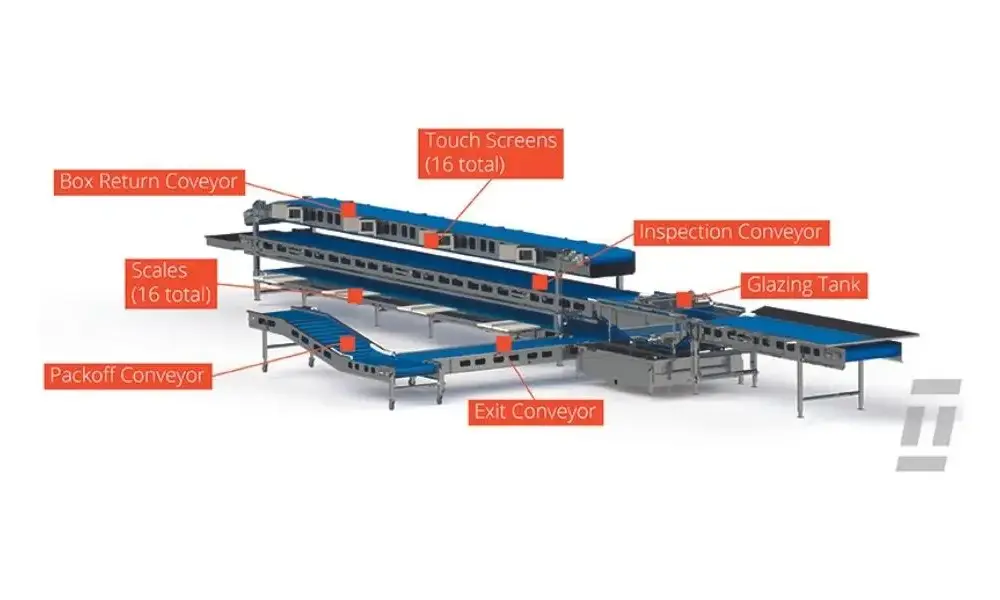
Automated conveying and handling equipment creates a controlled path through the plant. Fish can move between processing stages with fewer manual interventions, helping operators maintain a predictable flow while reducing repetitive lifting and carrying.
This is particularly valuable in high-throughput environments, where even small inefficiencies are repeated hundreds or thousands of times per shift.
Automated equipment can help:
- Minimize manual product transfers
- Reduce product damage caused by excessive handling
- Maintain a consistent production flow
- Reduce repetitive lifting and ergonomic strain
- Connect individual processing stages into a more cohesive system
The result is a process that is less dependent on manual movement and easier for plant personnel to control.
2. Automated Fish Washing Improves Process Consistency
Washing is a critical part of seafood processing, but manual washing methods can produce variation in water coverage, contact time, and product movement.
Automated fish washing equipment can provide a more consistent and repeatable process. Fish can be conveyed through a controlled washing zone while water is applied according to the requirements of the application.
For plant engineers, automation also provides greater control over the process. Water flow, conveyor speed, and other operating parameters can be integrated into the overall line design, making it easier to establish repeatable operating conditions.
Consistent washing can support:
- More uniform product treatment
- Reduced manual handling
- Better integration with upstream and downstream equipment
- More predictable production rates
- Improved process control
Automation doesn’t eliminate the need for sanitation and good operating practices, but it can make the washing step more controlled and repeatable.
Explore our Seafood Processing Equipment
3. Automated Glazing Helps Deliver a More Uniform Product
Glazing frozen seafood is another process where consistency matters. An uneven glaze can affect product appearance, protection, yield, and overall product specifications.
Automated glazing equipment can help processors establish a repeatable process by controlling how product moves through the glazing system and how the glaze is applied.
For improvement teams, this repeatability is particularly important. Instead of relying heavily on operator technique, an automated system can provide defined process parameters that can be monitored, adjusted, and optimized.
Depending on the application, automation can help processors pursue:
- More consistent glaze coverage
- Better control of production parameters
- Reduced manual handling
- Improved line integration
- More repeatable product results
When combined with automated conveying, glazing can become a seamless part of the production flow rather than a standalone manual operation.
4. Automated Dumping Can Improve Ergonomics and Material Flow
Dumping fish from bins, totes, or containers is a task that can place significant physical demands on operators. Repetitive lifting and tipping can contribute to ergonomic risks while also creating bottlenecks when production rates increase.
Automated dumping systems provide a controlled way to transfer product from containers into the processing line.
For maintenance and improvement officers, the benefit extends beyond labor reduction. Automated dumping can help synchronize material handling with the rest of the line, reducing interruptions and keeping fish moving at the required rate.
A well-integrated dumping system can help:
- Reduce manual lifting and tipping
- Improve operator ergonomics
- Create a more consistent feed rate
- Reduce transfer bottlenecks
- Connect raw material handling with downstream processing
The key is designing the dumper around the actual production environment—including container type, product characteristics, required throughput, sanitation requirements, and available floor space.
5. Automated Conveying Keeps Fish Moving
Conveyors are the backbone of many automated seafood processing lines. They provide the physical connection between individual machines and help transform a collection of processing steps into a coordinated system.
Automated fish transport can be used to move product through washing, glazing, inspection, packing, freezing, and other stages with minimal manual intervention.
For plant engineering teams, conveyor automation can also provide flexibility. Variable speeds, controlled transfers, accumulation, and integration with other equipment can help the line respond to changing production requirements.
The goal isn’t simply to move fish from point A to point B. It is to move product predictably, efficiently, and hygienically while maintaining the required production rate.
6. Automation Can Improve Maintenance and Troubleshooting
Modern automation can provide benefits beyond production. When equipment is properly instrumented and integrated, plant personnel can gain greater visibility into how the line is operating.
Sensors, controls, alarms, and other monitoring capabilities can help maintenance teams identify problems more quickly and understand where interruptions are occurring.
For example, monitoring equipment operation can help teams identify:
- Recurring stoppages
- Conveyor speed or flow issues
- Equipment overloads
- Transfer problems
- Conditions contributing to downtime
This information can support preventive and predictive maintenance strategies and give continuous improvement teams better data for deciding where investments will have the greatest impact.
7. Automation Makes Process Improvement More Measurable
One of the biggest advantages of automation is that it turns processes into something that can be measured and controlled.
A manual process may depend on individual operator experience. An automated process can often be defined by parameters such as conveyor speed, cycle time, throughput, water flow, or equipment operating status.
That creates opportunities for continuous improvement.
Instead of asking, “Why does this part of the line keep slowing down?” teams can begin using production data to identify patterns and quantify the problem.
Over time, this can support improvements in:
- Throughput
- Downtime
- Labor utilization
- Product consistency
- Equipment reliability
- Line balancing
- Overall equipment effectiveness
Explore Automation & Line Control
8. The Best Automation Connects the Entire Process
Automation delivers the greatest value when individual machines are designed as part of a complete processing system.
A fish washing machine operating efficiently is useful. A glazing system operating consistently is useful. An automated dumper can eliminate a difficult manual task. Conveyors can move product between them.
But when these systems are properly integrated, the benefits multiply.
A coordinated line can move fish from dumping → washing → processing → glazing → conveying → packing with fewer manual transfers and fewer opportunities for bottlenecks.
This is where experienced equipment design matters. Automation should be engineered around the plant’s production goals, product characteristics, sanitation procedures, maintenance capabilities, and future expansion plans—not simply added as individual machines.
Automation Is an Investment in the Entire Plant
For seafood processors, automation is about more than reducing the number of manual tasks. It is an opportunity to build a more controlled, consistent, and efficient production environment.
Automated washing, glazing, dumping, and conveying can reduce unnecessary product handling, improve ergonomics, support consistent production, and provide the control and data needed for ongoing process improvement.
For plant engineers and maintenance and improvement teams, the most important question is not simply “Where can we automate?”
It is:
“Where can automation create the greatest improvement in the overall process?”
That question leads to better equipment decisions—and ultimately to a seafood processing line that is easier to operate, maintain, measure, and improve.
Ready to Explore Automation Opportunities?
At Innotech Process Equipment, we help seafood processors identify practical opportunities to automate product handling and processing. From fish washing and glazing to automated dumping and conveying, the right equipment can be engineered to work as part of an integrated production system.
If you’re evaluating a new processing line, upgrading existing equipment, or looking for ways to eliminate bottlenecks, start by looking at where manual handling and inconsistent flow are limiting your operation. Those areas may offer some of your best opportunities for automation.