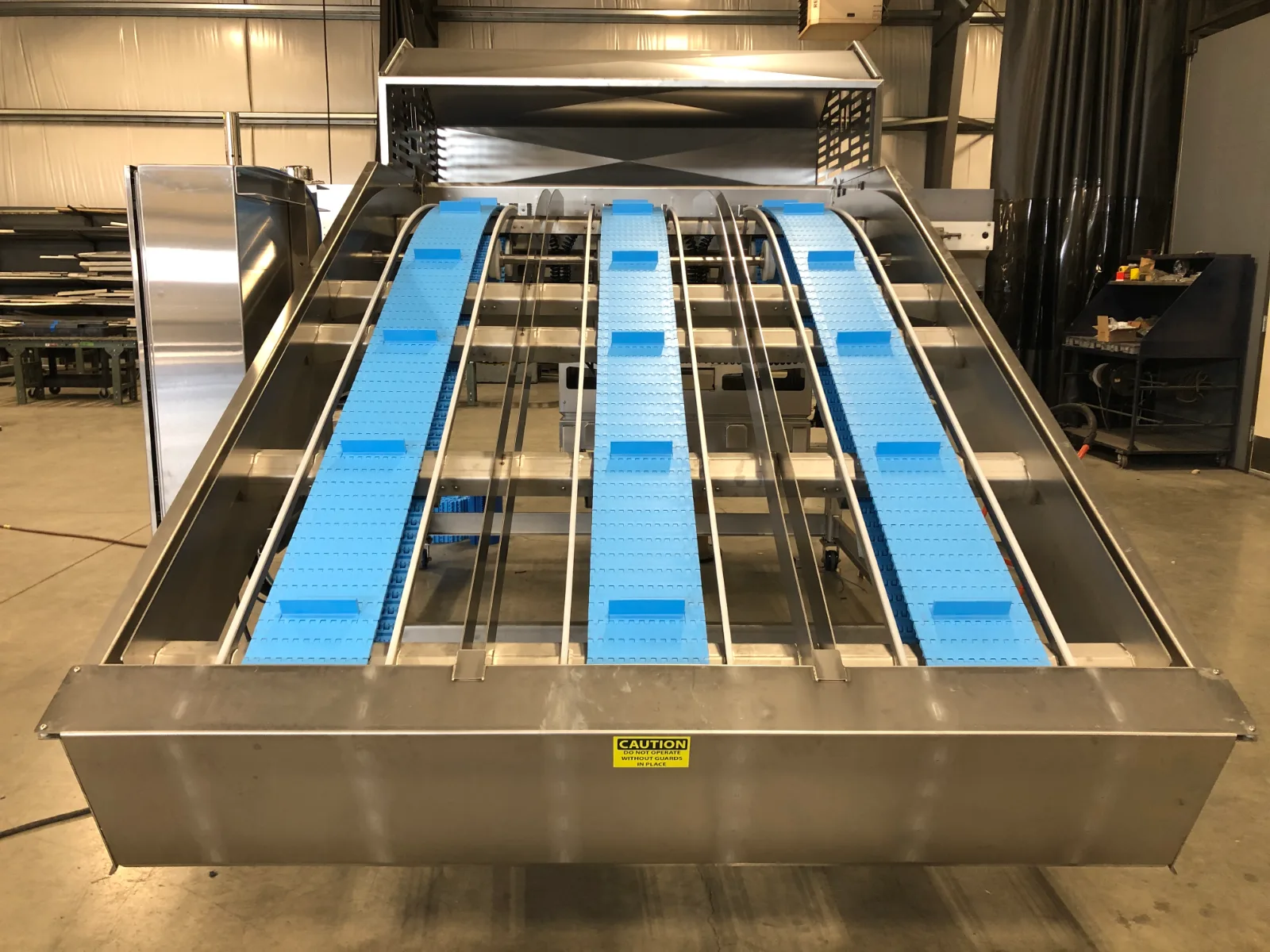
Lug, Crate & Flat Dumpers
Gentle, metered container dumping in one-, two- and three-lane configurations. No changeover between container styles, and it installs in your line rather than beside it.
Innotech lug, crate and flat dumpers, known internationally as lug tippers or crate tippers, empty lugs, flats and trays onto your line gently and at a steady rate. They do one job well: put an even bed of product in front of the next machine, at a rate that machine can use.
We build them in one-, two- and three-lane configurations. The three-lane is our best seller. Units run in North America, Europe and South America.
Every unit is designed and built in Bellingham, Washington, in stainless steel, by the same people who answer the phone when you call about it.
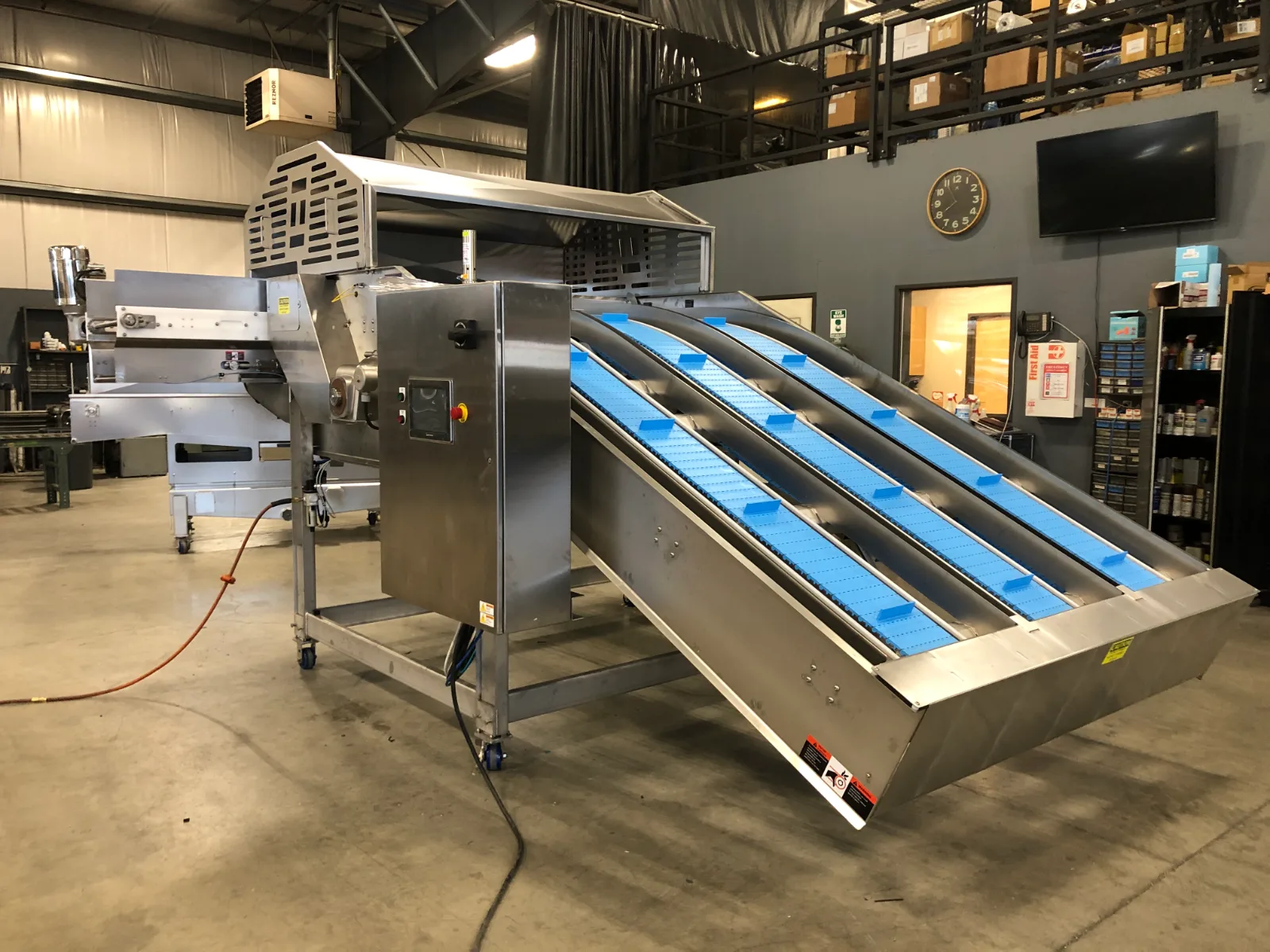
What sets it apart
No changeover
Clamping adjusts itself to each container. Switch between the container styles the machine is set up for and it keeps running. No tools, no downtime.
In the line, not beside it
It installs in line with the process instead of off to the side or out into the aisle. On a retrofit, that is often the difference between a project and moving walls.
Empties leave on their own
Emptied containers eject to the side onto their own takeaway conveyor. Run it to a washer and nobody handles them again.
Throughput by lane count
Throughput follows the container, not the machine. A blueberry lug carries about 26 pounds, and each lane tips 10 to 11 containers per minute, about one every six seconds. Raspberry flats are longer and carry less, so the same cycle rate moves less product. Choose the lane count by what the equipment downstream can take.
| Configuration | Containers per hour | Pounds per hour | Operators at infeed |
|---|---|---|---|
| Single-lane | 600 to 660 | 15,600 to 17,200 | 1 |
| Two-lane | 1,200 to 1,320 | 31,200 to 34,300 | 2 |
| Three-lane | 1,800 to 1,980 | 46,800 to 51,500 | 3 |
Blueberry lugs at approximately 26 lb. One operator loads each lane at full rate at the infeed. Send us your container and we will give you the rate for it.
Each operator places one container on the infeed every six seconds. No pouring by hand, no watching the belt to judge whether the sorter is getting too much or too little.
What it changes at the dump station
Hand dumping is easy to stop noticing. The positions are filled, the work gets done, and the cost sits in the wage line.
A lane still needs a person. What changes is the job. The operator places a container on the infeed and lets go. The machine sets the pour, so the line gets the same bed whoever is on shift, at the start of the shift and at the end of it.
- No tipping a loaded container by hand.
- No judgment call about pour rate.
- No empties to stack, carry or move. They leave on their own conveyor.
An even bed, not a wave
A sorter can only grade what it can see. Product arriving in surges gives it a heavy bed, then a gap, then another heavy bed. In the heavy stretch, fruit piles up and the camera reads the top layer. In the gap, the line runs and nothing is graded.
Our hopper-fed dumpers hold the hopper at a set level and meter product onto the belt, so the line downstream sees a steady depth of product rather than surges.
For IQF and processed lines that want maximum flow rather than metered flow, we build a high-volume configuration without the hopper.
It started with a blueberry problem
The first one was built for a blueberry line that needed flats emptied onto a slow belt evenly enough for an optical sorter downstream to do its job, and hand dumping was not getting there. Poured too fast, the fruit piled and bruised. Poured too slowly, the sorter starved.
So the machine was built around the pour rather than around the container. Today the same design runs blueberries, raspberries and strawberries.
Containers it handles
The machine runs the lugs, flats and trays we see in berry plants. Blueberry lugs are the tallest containers we run; raspberry flats are the longest and the shortest. A width change may call for guides on the intake lanes to center the container, which is a one-time setup.
Containers are loaded one at a time, one operator per lane. That is why the machine earns its keep fastest on larger containers: a lane moving 26-pound lugs moves about four times the product of a lane moving 6-pound trays, for the same operator effort.
Running a container we have not seen? Send us the dimensions and loaded weight and we will tell you plainly whether it runs.

The empties, and the wash line
Emptied containers eject to the side onto their own conveyor. Run that conveyor to a washer and the container goes from full, to empty, to washed, without a person touching it after it reaches the infeed.
We build the lug and flat washers too, so if you are specifying both, they are designed as one flow.
Specifications
Length, height and hopper capacity are built to your line rather than fixed. Tell us the space and the rate and we will give you the layout. Download the one-page spec sheet (PDF).
| Item | Specification |
|---|---|
| Configurations | One, two or three lanes |
| Cycle rate | 10 to 11 containers per minute, per lane |
| Infeed | Single container, operator loaded. One operator per lane at full rate. |
| Changeover | None between container styles. Intake guides for a new width are a one-time setup. |
| Layout | In line with the process |
| Empty containers | Side ejected to a takeaway conveyor, ready for a wash system |
| Length, height, hopper | Configured to the line, or hopperless high-volume configuration |
| Construction | Stainless steel |
| Power | Any three-phase supply. Three-lane: 29.2 FLA at 230 VAC. One- and two-lane can be lower. |
| Compressed air | Approximately 40 psi |
| Other utilities | None |
| Controls | Touch screen in English and Spanish. UL Type 4X enclosure. VPN router for remote support. |
| Installation | Your contractor sets the machine and makes the field power and air connections. On-site commissioning and training available. |
Options
- One, two or three lanes
- Receiving hopper with level control, or hopperless high-volume configuration
- Discharge conveyors sized to the line they feed
- Takeaway conveyor routing to your wash system
- Modular belting options
- Intake lane guides for a specific container width
- Washdown locking casters
- Adjustable height
- International power for any three-phase supply
- On-site commissioning and operator training
Controls, and the people behind them
The touch screen runs in English and Spanish, so the crew reads it in the language they think in. The control panel is built in our own UL 508A panel shop under the direction of a licensed professional engineer, and we design for any three-phase supply, worldwide.
Every panel is fitted with a VPN router for remote support. When something needs attention, our engineer can connect to the machine while your maintenance lead is standing in front of it, make the change and watch it run. Updates and custom changes are made the same way, usually without a service trip.
Units can ship ready to run without us on site; your contractor makes the power and air connections. When you would rather have us there for startup and operator training, we travel.

Lug and crate dumpers, or tote and bin dumpers?
The container decides the machine. Lugs, flats and trays are small enough to handle by hand, and an operator feeds them to these machines one at a time. Totes and bins are too large to handle by hand, which takes a different machine. If you receive in totes or bins, see our tote dumpers. If you run both, we build both. See how the pieces fit together in a complete container receiving system.